 Station Road before Castle Park was built. c. 1950
Station Road, Hemyock
26th June 2011 by 1 Comment
Modern view from the Church tower.
26th June 2011 by Leave a Comment
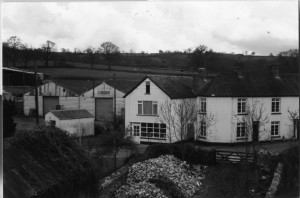 Modern view from the Church tower. The smaller white building on the left (recently demolished) was once the Midland Bank Agency Office. The property in the centre of the picture was a shop for many years, last used as a butchers, it is now a private house.
Looking at the Pump down the High St, early 1900’s
25th June 2011 by Leave a Comment

Looking down the High St. towards the Pump. The cottages have climbing roses against their walls.
To the left of the Pump there is farm machinery on display in front of the blacksmiths.
Aerial View of Hemyock in 1980’s
25th June 2011 by Leave a Comment
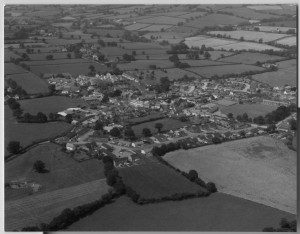 Early 1980s. Aerial View of Hemyock from the S.E. with Churchills and Prowses in the foreground. Higher Mead, East Mead, Redwoods Close and Culm Meadows have yet to be built.
Castle Farm Cart at Wagon and Engine Shed
16th June 2011 by 1 Comment
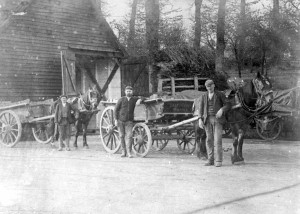
Castle Farm cart at Engine and wagon shed Hemyock 1920
The front horse and cart is from Castle Farm Hemyock with others after delivering milk churns to station. The building is the Engine and Wagon shed at the station.
Upottery Home Guard 1939-45
22nd April 2011 by 15 Comments
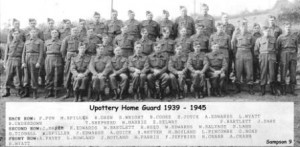
The men of Upottery Home Guard
The picture shows 37 members of the Upottery Home guard (1935-1945)
Back row: F. Pym, M. Spiller, Richard Drew, Stanley Wright (Stanley Arthur William Wright born 1921 in Kilmington moved to Highley Farm, Upottery in 1931), Bert Cooke, Ern Joyce, A. Edwards, Len Wyatt, Reg Underdown, Tom Shepherd, Will Harris, Ed Selway, F. Bartlett and Jack Dare.
Second row: J. Baker, R. Edwards, William Bartlett, Cpl. Raymond Reed, W. Edwards, W. Salvage, Stanley Lane, B. Tidball, ? Spiller, J. Edwards, Arthur Quick, S. Retter, Henry Boyland, L. Pincombe and George Bond.
Front row (seated): Cpl. Alf Pavey, Cpl. Les Rowland, Sgt. J. Boyland, (Officer, rank unknown) W. Parris, (Officer, rank unknown but appears to be Lt.) F. Jefferies, Sgt. H. Crabb, Sgt. A. Crabb and Sgt. R. Wyatt.
Can you help with first names?
Coldharbour Mill Steam Engines
20th April 2011 by Leave a Comment
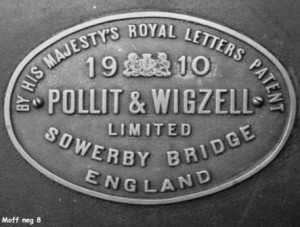
Pollit and Wigzell engine plate dated 1910
Coldharbour Mill is a 200 year old spinning mill, built by Thomas Fox, to spin woollen and later worsted yarns. The Mill is a rare example of surviving Georgian architecture, industry and enterprise and is based in Uffculme, Devon.
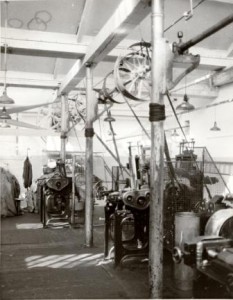
Machinery at Coldharbour Mill
The Steam Engines are regularly started up and on display to the public.
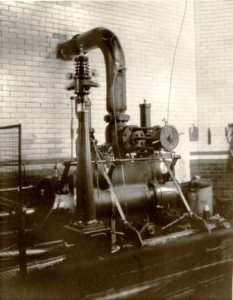
Steam power made the mill one of the most successful in the country
The mill was famous for the production of putties, for the British Army.
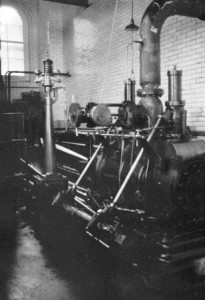
Some of the engines are still in working order
Uffculme Jam and Cider Factory
4th April 2011 by 2 Comments
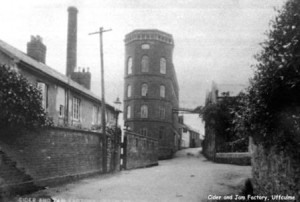
Uffculme Jam and Cider Factory. 1974
On the corner of East Street, High Street and Ashley Road is the listed building that has been a brewery and general business building. In this 1974 picture, the building was being used as a Jam and Cider Factory.
It was originally built by William Furze, in 1858. The red brick construction sits on a stone plinth. The tower has a slate roof clevely concealed by parapet.
The polygonal building is four stories high and has a date stone set high which reads ‘Built W.A.D.F. 1858‘.
The Old Brewery is a prominent landmark in Uffculme.
Furze’s Probate of will and codicils lists simply him as, ‘Brewer‘. The documents (reference O/064/008) are available to the public, at the London Metropolitan Archives. The documents were drafted in 1845 and 1855.
From the Bridge at Uffculme
4th April 2011 by 1 Comment
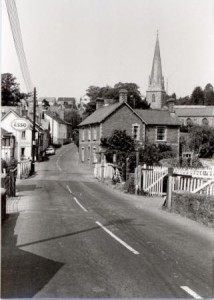
View from the bridge, looking north-west with Denners Way on the right
Little has changed in this view of Bridge Street, Uffculme. Probably taken in the early 70s, as the railway lines have been removed, although the level crossing gates are still shown.
The Esso garage appears to have the name of the proprietor shown as Featherstone. Perhaps you can recall the Featherstone’s or are part of the family?